Criminal Records in Multnomah County can be accessed quickly through the county’s online database, where users enter a name, date of birth, or case number to retrieve arrest information, charges, and disposition details. The portal pulls data from the Multmultnomah County criminal record search system, showing felony, misdemeanor, and pending case statuses, while also indicating if a record is sealed or expunged. This immediate view helps landlords, employers, and citizens verify background facts without costly delays.
Criminal Records searches also support specific queries like Multnomah County criminal records by case number or by name, offering links to official court documents and sentencing summaries. Users can request certified copies through the Multnomah County Circuit Court Records Department, which provides clear fee structures and processing times. By matching identifiers such as case numbers and birth dates, the system reduces common errors like duplicate or outdated entries, ensuring reliable results for any public‑access need.
How to Search Criminal Records
Finding criminal records in Multnomah County, Oregon takes only a few minutes when you use the right portal. The Oregon Judicial Department’s online system lets anyone search through the official multnomah county or portal to review court records by name, date of birth, or case number. People use these searches for many reasons: employers checking job applicants, landlords screening tenants, lawyers building case files, and family members verifying someone’s past. The system pulls data directly from the Multnomah County Circuit Court, so results reflect the same information the clerk has on file.
Official Search Portal: https://www.courts.oregon.gov/courts/multnomah/pages/default.aspx
Before you start, have key details ready. A full legal name works best, and adding a date of birth sharpens accuracy. If you already have a case number, the search becomes instant. The portal is free to use for basic lookups, and certified copies carry a small fee. Below are the steps for running a search on the Multnomah County portal.
Steps to Search
- Open the Oregon Judicial Department website at the URL listed above.
- Look for the “Court Records” or “Case Search” link on the Multnomah County page.
- Choose your search method: name, date of birth, or case number.
- Type the person’s full legal name (last, first, middle) into the name field.
- Add a date of birth if you have it — this filters out people with the same name.
- Or type the full case number if you know it (for example, 22CR12345).
- Click the “Search” button and wait for the system to load results.
- Review the list of matching cases — each one shows charges, court, and status.
- Click any case to see full details like filings, hearings, and disposition.
- Print or save the page if you need a copy for personal records.
Search by Name
A name search is the most common starting point for criminal record lookups. Type the last name first, then the first name, exactly as it appears on legal documents. The system matches against court filings, so small spelling differences can change your results. Try variations if your first attempt shows nothing — many people go by nicknames or shortened first names in daily life. Common surnames like Smith, Johnson, or Martinez often return many matches, so adding a date of birth becomes important.
Search by Date of Birth
Adding a date of birth to any search cuts down on wrong matches. This field narrows results to one specific person when names repeat often. The portal accepts month/day/year format. If you only know the year, type it into the year field and leave month and day blank. Date of birth works as a standalone filter too, useful for identity verification or skip tracing.
Search by Case Number
Case numbers give the fastest, most precise results. Each Multnomah County criminal case carries a unique number like “21CR45678” or “23FE12345.” The first two digits show the year, followed by a code telling you the case type (CR for misdemeanor, FE for felony, etc.). If you have this number from a citation, police report, or prior legal document, paste it directly into the case number field. You’ll skip name searches entirely and land on the exact case file.
Search by County or Jurisdiction
Criminal records stay with the county where the case was filed, not where someone lives now. Multnomah County cases only show up in the Multnomah County database. If the person has cases in other Oregon counties — like Washington, Clackamas, or Lane — you need to search those county portals separately. The Oregon Judicial Department lists links to every circuit court on its site, so you can move between them.
Information Needed for a Search
The more details you bring, the better your search works. At the top of the list: full legal name, date of birth, and case number. Helpful extras include an approximate case year, the type of offense (felony or misdemeanor), and the court location. You do not need to register an account, pay money, or share personal details to run a public search. For certified copies, the court asks for proof of identity and a small fee.
Multnomah County Criminal Record Details
A single criminal record in Multnomah County carries several key data points. Each piece comes from the original court filings and stays on file with the clerk. Reading these fields carefully helps you tell whether the case is still open, what the final outcome was, and whether any sentence is still active. Here’s a closer look at what each field means and why it matters.
Person Identification
The person identification section lists the full legal name on file, plus any known aliases. It also shows the date of birth used during booking or first court appearance. Some records include a physical description, address at time of arrest, or last known residence. This section anchors every other piece of data — all charges, court dates, and sentences tie back to the named individual.
Arrest Date and Agency
Each arrest record shows the exact date the person was taken into custody. The arresting agency — often Portland Police Bureau, Multnomah County Sheriff’s Office, or Oregon State Police — appears next to the date. Multiple arrest dates can exist for the same person, since one criminal event sometimes leads to warrants served later. The agency name helps you understand jurisdiction and cross-check public records.
Criminal Charges
The charges section lists every offense the state filed against the defendant. Each charge includes the Oregon statute number, a short description (like “Assault IV” or “Theft II”), and the filing date. Charges can change during a case — prosecutors may drop some, add others, or amend descriptions. The record shows the original charge alongside any amended version, so you see the full history of what was alleged.
Offense Classification
Oregon groups criminal charges into classes: felonies, misdemeanors, and violations. Felonies (marked FE) include serious crimes like robbery, burglary, and major drug offenses. Misdemeanors (marked CR) cover lesser offenses such as simple assault, minor theft, or DUII first offense. Violations are the least serious and often include traffic infractions. The classification determines potential sentence length and where the case is tried.
Case Number and Court
Every criminal case in Multnomah County carries a unique identifier. Case numbers follow a pattern: the year, a code for case type, and a sequence number. The court listed on the record is almost always Multnomah County Circuit Court at 1200 SW 1st Ave., Portland, OR 97204, since this is the only circuit court in the county. Knowing the case number lets you pull records quickly without name searches.
Disposition
The disposition is the final outcome of a criminal case. Common dispositions include conviction, dismissal, acquittal, diversion, or plea agreement. Each one carries different weight — a dismissal means the state dropped the case, a conviction means the defendant pleaded guilty or lost at trial. The exact wording matters for background checks, and the record shows the date the judge entered the disposition.
Sentence
If the disposition is a conviction, the sentence section lists the penalty imposed. Sentences range from fines and probation to prison terms measured in months or years. The record shows probation length, jail time credited, fines owed, and any required programs like treatment or community service. Suspended sentences appear here too, with notes on what happens if the person violates probation terms.
Types of Criminal Records
Not all criminal records look the same. The type of record depends on the charge level, the stage of the case, and what happened in court. Knowing the difference helps you read results accurately and request the right documents. Below are the main categories you’ll see in Multnomah County searches.
Felony Records
Felony records cover the most serious criminal charges in Oregon. These include violent crimes, major theft, sex crimes, drug trafficking, and offenses carrying more than one year in prison. Multnomah County handles most felonies at its main courthouse. Felony cases move through arraign, then preliminary hearings or grand jury review, then trial or plea. Sentences can run from 18 months to life, depending on the crime.
Misdemeanor Records
Misdemeanor records cover less serious offenses like simple assault, theft of low-value items, minor drug possession, and first-offense DUII. These cases carry sentences of up to one year in jail and fines up to $6,250 in Oregon. Misdemeanor trials are shorter, often resolved in a single day. Many misdemeanor cases end in plea deals or diversion programs for first-time offenders.
Arrest Records
Arrest records document the fact that someone was taken into custody. They include the arrest date, location, agency, and reason for arrest. An arrest record exists even if the case gets dismissed later — the arrest still happened. These records come from law enforcement, not the court. You can view arrest information through the Multnomah County Sheriff’s Office or the Portland Police Bureau.
Conviction Records
Conviction records show that a court found the person guilty, either through a guilty plea or trial verdict. These are the records most employers, landlords, and licensing boards care about. They include the conviction date, statute violated, and sentence imposed. Conviction records stay on file permanently unless a court grants expungement under Oregon law.
Pending Case Records
Pending case records cover charges that are still moving through court. No final outcome exists yet — the case is waiting for hearings, plea negotiations, or trial. Status notes show what step the case is at (arraignment, pretrial conference, jury trial set). Pending records signal that a person has open legal exposure but no final judgment yet.
Dismissed Case Records
Dismissed case records show the court or prosecutor dropped the charges. Dismissals happen for many reasons: lack of evidence, witness problems, successful motions, or diversion completion. The record still exists, and anyone running a background check can see it. A dismissal is not the same as an acquittal — dismissed cases did not go to a verdict.
Historical Records
Historical records cover older cases, often from decades past. Many pre-2000 cases have been microfilmed or scanned, with limited online access. To view older records, you may need to visit the Multnomah County courthouse in person or order copies through the Records Department. Historical records remain public unless sealed by court order.
Criminal Record Status
The status field on a criminal record tells you where the case stands right now. Status changes as the case moves through court — from initial filing to final resolution. Reading the status correctly helps you avoid misinterpreting old information as current. The list below explains each status you’ll see in Multnomah County records.
Active Cases
Active cases are open and ongoing in the court system. They have not reached a final disposition. An active case means hearings are still scheduled, motions are still filed, or a trial date is set. People with active cases should resolve them before applying for jobs or licenses that ask about criminal history.
Pending Cases
Pending cases sit in queue waiting for their next hearing. They are part of the active caseload. Pending does not mean forgotten — courts process thousands of cases each year, and scheduling depends on court resources. The pending status often shows alongside the next scheduled date.
Closed Cases
Closed cases have reached a final outcome and are no longer active. Closing a case means the court has nothing more to do unless an appeal is filed. Closed cases still appear in searches but won’t show new hearing dates. Most Multnomah County criminal cases close within one to two years of filing.
Dismissed Cases
Dismissed cases closed because the prosecutor or judge ended them without a conviction. Dismissals often follow successful pretrial motions, completion of diversion, or dropped complaints. Dismissed cases show as closed with a “dismissed” disposition. They remain visible in public records unless sealed.
Convicted Cases
Convicted cases closed because the defendant pleaded guilty or lost at trial. These cases show a conviction disposition and a sentence. The sentencing portion of the record is fully visible. Convicted cases have the strongest impact on background checks, professional licensing, and firearm rights.
Acquitted Cases
Acquitted cases closed because a jury or judge found the defendant not guilty. An acquittal is different from a dismissal — it means the case was fully tried and the prosecution failed to prove guilt beyond a reasonable doubt. Acquitted cases show as closed with a “not guilty” disposition. They remain in public records but signal a successful defense.
Expunged or Sealed Records
Expunged or sealed records are hidden from public view by court order. Oregon law allows certain convictions to be expunged after a waiting period, typically 3 to 7 years depending on the offense. Once expunged, the record does not show up in standard searches. Sealed records remain in the court system but are not released to the public without a specific court order.
Criminal Records and Public Access
Most criminal records in Oregon are public. State law presumes openness for court records, and the Oregon Judicial Department follows that principle. Some exceptions exist for sensitive cases. Understanding what is open and what is sealed helps you run searches that match your needs and respect legal limits.
Publicly Available Records
Publicly available records include most criminal court files, case summaries, and disposition records. Anyone can view them without explaining why. The Multnomah County Circuit Court makes these records available through its online portal and at the courthouse front desk. No account or login is required for basic searches.
Online Criminal Records
Online criminal records are available 24 hours a day through the Oregon Judicial Department’s case search system. The portal updates regularly, though some recent through the official obituary records portal to review filings may take a few days to appear. Online records show case number, parties, charges, hearings, and dispositions. They do not include sealed files, juvenile records, or expunged cases.
Restricted Information
Restricted information is removed from public view by law. This includes Social Security numbers, victim identifying details in sex crime cases, juvenile identifiers, and certain mental health records. Court staff redact these fields before showing files to the public. Anyone requesting restricted information without legal authority could face penalties.
Sealed Records
Sealed records exist in the court system but are not visible in public searches. A judge issues a sealing order, often after a petition from the defendant. Common reasons include completed diversion programs, certain dismissed cases, and specific conviction types that qualify under Oregon’s expungement statute. Sealed records can sometimes be reopened by court order.
Juvenile Records
Juvenile records cover criminal cases where the defendant was under 18 at the time of the offense. Oregon keeps most juvenile records confidential. They do not appear in standard public searches and cannot be viewed without a court order. Some juvenile adjudications can be expunged when the person turns 18 or 23, depending on the case.
Records Available by Request
Records available by request include documents not shown in the online summary. Court orders, motions, exhibits, and full case files fall into this category. To request them, contact the Multnomah County Circuit Court Records Department. Requests can be made in person, by mail, or sometimes by phone. Copies carry a per-page fee.
Obtaining Official Criminal Records
Official criminal records come straight from the court or law enforcement agency. They carry more weight than online summaries because they include court seals, signatures, and certified stamps. People request official records for immigration, professional licensing, expungement petitions, and court filings. Below are the main ways to get them in Multnomah County.
Online Requests
Online requests work for documents stored in the court’s electronic system. The Oregon Judicial Department portal lets users pull case summaries and basic records. For certified copies, the portal links to a request form. You fill in the case number, your contact details, and the document type. Payment is by credit or debit card.
Court Record Requests
Court record requests go through the Multnomah County Circuit Court Records Department. Submit your request in writing, including the case number, party names, and what documents you need. The Records Department charges per page and per document. Most requests are processed within 5 to 10 business days.
Law Enforcement Requests
Law enforcement requests come from police agencies and sheriff’s offices. The Multnomah County Sheriff’s Office handles arrest records and booking reports. Portland Police Bureau records are available through their Records Division. These requests typically require a written application, identification, and a stated purpose for the records.
In-Person Requests
In-person requests work best for immediate needs. Visit the Multnomah County courthouse at 1200 SW 1st Ave., Portland, OR 97204. The Records Department counter handles walk-in requests during business hours, Monday through Friday. Bring a valid photo ID and case details. Same-day service is often available for simple requests.
Certified Copies
Certified copies carry the court seal and signature of the clerk. They are official documents accepted by other courts, government offices, and licensing agencies. Certified copies cost more than regular copies. Each Multnomah County certified copy runs $5 for the first page and $1 for each additional page, with a $5 certification fee added.
Fees and Processing Times
Accuracy and Limitations
Even the best criminal record systems have limits. Names get misspelled, dates shift, and old data lingers in older databases. Knowing the limitations helps you use records responsibly and catch errors before they cause problems. The following sections explain what to watch for when reviewing Multnomah County records.
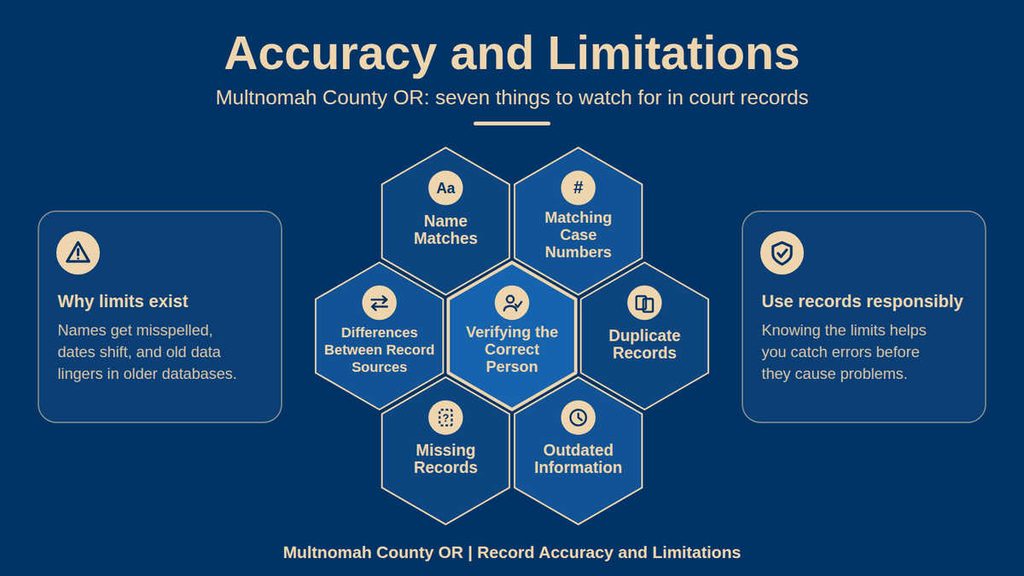
Verifying the Correct Person
Verifying the correct person means checking that every detail matches the individual you’re researching. Names, dates of birth, and addresses help confirm identity. Never rely on a name match alone — many people share common names. Cross-check with date of birth and other identifying details whenever possible.
Name Matches
Common name matches happen when the system finds multiple people with the same name. Surnames like Garcia, Smith, and Lee return thousands of results nationally. Multnomah County alone may have hundreds of cases with these surnames. Always filter with additional identifiers before drawing conclusions.
Matching Case Numbers
Matching case numbers is the most reliable way to confirm a record. Each case number points to one specific file. If you have a case number from a citation, court summons, or prior legal document, use it. Case number searches return one result every time.
Duplicate Records
Duplicate records happen when the same case appears more than once in search results. This often happens with older data or when multiple agencies report the same booking. Court staff work to remove duplicates, but some stay in the system. Look at case numbers to spot duplicates — the same number should not appear twice in a clean list.
Outdated Information
Outdated information refers to records that no longer reflect current status. A case listed as “pending” may have closed months ago. Dispositions sometimes lag behind actual events. The Oregon Judicial Department updates its portal regularly, but a delay of a few days to a few weeks is normal for recent filings.
Missing Records
Missing records happen when a case that should be on file does not show up in searches. This often occurs with very old cases, sealed records, or cases filed under different name spellings. Court archives hold the original documents even when online searches show nothing. Contact the Records Department for help locating missing files.
Differences Between Record Sources
Differences between record sources show up because various agencies maintain their own databases. Court records, sheriff’s records, and state police records may show slightly different information depending on what they track. Court records focus on case outcomes. Police records focus on arrests. Background check companies pull from multiple sources and may combine them differently.
Criminal Records Search Problems
Search problems happen to everyone, from first-time users to legal professionals. Most issues have simple fixes once you know what to look for. The list below covers the most common problems people run into when searching Multnomah County criminal records.
No Record Found
No record found shows up when the search returns zero results. This can mean the person has no criminal record in Multnomah County, the name spelling is wrong, or the case is sealed. Try name variations, check spelling, and confirm you’re searching the right county. If results stay empty, the person likely has no public Multnomah County cases.
Incorrect Name or Spelling
Incorrect name or spelling causes most failed searches. Court records use the legal name at the time of filing. Hyphenated names, name changes after marriage, and common typos can all cause misses. Try the full legal name first, then variations. Many people go by middle names or nicknames, so search using all known forms.
Incorrect Case Number
Incorrect case numbers return “no record” even for cases that exist. A single wrong digit changes the result. Double-check the format — Multnomah County case numbers start with the year (two digits), a code like CR, FE, or VI, then the sequence. Old case numbers from decades past may have a different format.
Wrong County or Jurisdiction
Wrong county or jurisdiction produces empty searches even when cases exist. Multnomah County records only cover cases filed in Multnomah County. If the person was arrested in Portland but the case moved to Washington County, you need to search Washington County instead. The arrest happened in Multnomah, but the case venue matters.
Missing Information
Missing information refers to searches run with partial details. A first name alone often returns too many results to sort through. A date of birth alone may not match if you have the wrong year. Combining as many details as possible — full name, birth date, and case number — produces the cleanest results.
Restricted Records
Restricted records are hidden from public view. Juvenile cases, sealed files, and certain through the official criminal history portal to review expunged records fall into this category. A “no record” result for someone you believe has a record often points to restricted status. Only a court order can unlock restricted files.
Delayed Updates
Delayed updates affect recent filings. A case filed today may not appear in the online portal for several business days. Court staff enter data manually in some cases, and backlogs happen during busy periods. If you can’t find a recent record, wait a few days and try again.
Use Cases for Criminal Records
Criminal record searches serve many practical purposes across Oregon. Employers in Portland and across Multnomah County often run checks on job applicants, especially for roles involving children, vulnerable adults, or financial responsibility. Landlords screen tenants to protect property and other residents. Volunteer organizations use records to verify the safety of people working with at-risk populations. Lawyers build case files by reviewing opposing parties’ histories. Each user benefits from reliable, current data pulled directly from the court’s official systems.
Oregon’s Public Records Law and Criminal Records
Oregon’s Public Records Law strongly favors open access. State law presumes court records are open, with limited exceptions for specific case types. Multnomah County follows this principle by publishing criminal records online without requiring users to register or explain their purpose. The law does allow redaction of certain sensitive details like Social Security numbers and juvenile identifiers. Anyone denied access to a record they believe should be public can appeal through the Oregon Public Records Advocate.
Expungement Eligibility in Multnomah County
Oregon’s expungement statute sets specific eligibility rules. Most misdemeanor convictions can be expunged 3 years after the case closes. Most felony convictions need 5 to 7 years, depending on the offense class. Dismissed cases can often be expunged right away. The Multnomah County Circuit Court processes expungement petitions through its Records Department. Successful expungement removes the record from public view, though law enforcement and certain licensing agencies may still see it.
How Record Errors Get Corrected
Record errors happen, and Oregon courts have a process for correcting them. Common errors include misspellings, wrong birth dates, and incorrect charge descriptions. To fix an error, file a motion with the court that handled the case. The judge reviews the request and orders the correction if approved. The Records Department then updates the file. The process typically takes 30 to 60 days, depending on court workload.
Working with Multnomah County Records Staff
Court records staff help users with searches, copies, and corrections. They cannot give legal advice, but they can explain procedures, point you to the right forms, and clarify fees. Staff are available by phone during business hours and in person at the courthouse. Treat them with respect and have your case details ready before calling. The Multnomah County Records Department handles thousands of requests each month, so patience helps.
Digital Records and Paper Records
Multnomah County has been digitizing case files for decades. Most cases filed after 2000 exist in electronic form and show up in the online portal. Older cases exist on microfilm or paper, stored in the courthouse archives. To view older paper records, request access through the Records Department. The courthouse keeps these files secure and provides supervised viewing during business hours.
Privacy Considerations for Searchers
Public access doesn’t mean unrestricted use. Oregon law prohibits using criminal records to stalk, discriminate, or harass someone. The Fair Credit Reporting Act governs how employers and landlords use criminal records in decisions. Misusing criminal records can lead to civil liability. Always use the data for legitimate purposes and handle it responsibly.
Third-Party Background Check Services
Third-party background check services pull criminal records from various sources and combine them into reports. These services charge fees, often $25 to $100 per check. They provide convenience but may include errors due to database lag. For the most accurate results, the Oregon Judicial Department’s official portal remains the best free option. Use third-party services only when an employer or agency requires them.
Contact Details
To reach the Multnomah County Circuit Court Records Department directly, use the contact information below. Phone lines are staffed during regular business hours, Monday through Friday. The courthouse front desk accepts in-person record requests during the same window. Mail requests should include the case number, document type, and a return address with payment.
Frequently Asked Questions
Finding Multnomah County criminal records quickly helps employers, landlords, attorneys, and families verify legal history. The online court portal gives instant access to case details, charges, and outcomes. Knowing how to search, request copies, and understand record types saves time and avoids costly mistakes.
How can I search Multnomah County criminal records by name?
Visit the Oregon Judicial Department portal and select “Criminal Case Search.” Enter the full name, then add the date of birth for accuracy. The system returns a list of cases, each showing charge, filing date, and status. Click a case to view full docket. Results appear within minutes, making it easy to confirm a person’s criminal history.
What steps are needed to request a certified copy of a Multnomah County criminal record?
Call the Multnomah County Circuit Court Records Department at 971‑274‑0570 or go to 1200 SW 1st Ave. Fill out the Request Form, include a valid ID, and pay the $10 fee. The clerk processes the request within 10 business days. Certified copies carry the court seal and can be used for employment or licensing purposes.
Can I look up Multnomah County criminal case records using a case number?
Yes. On the online search page, choose “Case Number” as the filter. Enter the exact number and submit. The portal displays the case file, including charge details, court dates, and disposition. This method is fastest when you already have the official case identifier.
Where do I find Multnomah County misdemeanor and felony records online?
The public portal lists both misdemeanor and felony filings. After selecting “Criminal” as the category, use the drop‑down to filter by “Felony” or “Misdemeanor.” Each record shows the offense classification, plea, and sentencing information. This view helps compare the severity of different offenses.
How do I verify if a Multnomah County criminal record has been sealed or expunged?
Sealed or expunged files no longer appear in the public search. To confirm status, contact the Records Department with the person’s name and case number. If the record is sealed, the clerk will provide a written confirmation. This step is crucial for background checks that require current, unrestricted data.
What fees apply for Multnomah County criminal record searches and copies?
Online searches are free for basic case information. Certified copies cost $10 per document. If you need a detailed report or a rush service, the court may add a $5 surcharge. Payment can be made by cash, credit card, or check at the Records Department.